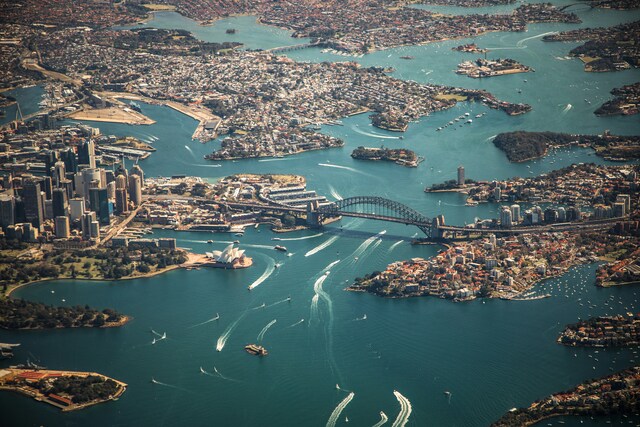
Sydney is often described as Australia’s pre-eminent global city – diverse, talented, and economically significant. But it underperforms as a unified innovation ecosystem.
That is the view of Dr. John Howard (Acton Institute for Policy Research and Innovation, Sydney/Canberra) who has recently undertaken research on the issue. He notes that Sydney’s innovation assets are impressive – top-ranked universities, a vibrant tech sector, leading health precincts, and a rich pool of knowledge workers.
However, in a comparative perspective, he says Sydney underperforms as a unified innovation ecosystem. It hasn’t yet achieved the coherence and collaborative intensity that define globally competitive innovation systems.
Assets without integration
Sydney’s innovation geography is based around its principal districts viz. Tech Central, Westmead, Macquarie Park, Randwick, Liverpool, Parramatta etc. Each shows distinctive strengths but they too often function in isolation, competing for attention, funding, and talent rather than acting as parts of a dynamic and interconnected metropolitan innovation ecosystem.
The lack of such an ecosystem limits the flow of knowledge, people, and capital, and undermines Sydney’s capacity to compete at the global frontier.
Howard’s recommendations include:
Move Beyond Asset Aggregation to System Integration, by establishing a Metropolitan Systems Integrator – The Committee for Sydney is currently taking a lead via the Innovation District Alliance.
Sharpen Specialisation and Global Branding i.e. ecosystems such as Quantum in Amsterdam, Boston life sciences.
Embed Networked Infrastructure – investment should be targeted at projects that tangibly link people, firms, and ideas across Sydney.
Foster trusted intermediaries.
Address short-termism and political cycle thinking – world-class innovation takes decades to mature. Need long-term strategies, patient capital.
Establish a Metropolitan Innovation Council or systems Integrator – to convene the actors and coordinate strategies.
Incentivise and measure collaboration.
Embed Global Benchmarking and Continuous Learning, including global innovation alliances.
Commission an Innovation Ecosystem Review, benchmarking Sydney against leading international ecosystems.
Benchmarking
I’d suggest that politicians and policy-makers would do well to consider the benchmarking issue raised above. Why? Well, local and overseas investors in high technology sectors intuitively look for well-developed ecosystems. This means that benchmarking, and the ability to compare different cities, would be a particularly useful guide for investors. In this context, it would be particularly interesting to compare Sydney with Melbourne, where my hunch is that the latter might be ahead. And insights into the innovation niches that have been pursued in Brisbane, Perth and Adelaide in recent years would also be fascinating.
Collaboration
Howard’s recommendations for incentivising and measuring collaboration are very appropriate. The economic literature is replete with articles about the critical role of collaboration in economic development. But it’s amazing how we really don’t embrace it.
Without getting too theoretical about it, government agencies – including local councils – are better-placed than the private sector to bring players to the table. It therefore follows that they need to employ people who are good at connecting with individuals and organisations to advance projects.
But the reality is that too many government staff don’t fit this profile – instead they are conservative, conforming and process-driven. This is not a criticism. It’s simply an observation, and I see it playing out daily here in Canberra. Very few public servants at the federal level are collaborative networkers these days, which means they’re loathe to tap the collaborative instincts of private sector players.
Specialisation & global branding
We tend to not appreciate that Australia has specialised ecosystems with global brands. Not huge numbers like in Europe or the USA, but enough to show the way. And it’s worth noting that each of them had a group of collaborative networkers to thank e.g. Maggie Beer, Wolf Blass etc. (Barossa Valley food/wine), Bruce Small (Gold Coast tourism), a succession of hospital administrators and scientists (Parkville medical precinct). They were invariably no-nonsense, outcomes-focused people.
Our specialised ecosystems have developed over decades with only a light dusting of formalised mechanisms, compared with the blueprint suggested by Howard. But it’s a complex world today – hence his proposed approach makes inherent sense.
Cairns’ quality roads
I was in Cairns recently, and the local economy appears, outwardly at least, to be bubbling along. An outstanding feature is the quality of its roads – smooth bitumen everywhere, no gravel, no potholes. Arguably the best in Australia, despite the humidity and high rainfall.
My travel party was thinking about the ‘how and why’.
One suggestion was that Cairns Regional Council has a good lobbying record, and plays to its relative remoteness when dealing with the feds and state Government. Indeed, I remember years ago a senior state bureaucrat saying that he drummed into his staff to never forget that Queensland has three zones – the north, central and south – and that any bureaucrat who forgot this would have a short career.
Another suggestion was that Cairns has had some big cyclones over the last twenty years (Abigail 2001, Larry 2006, Yasi 2011, Jasper 2023) and that the federal/state recovery packages have funded the roadworks. This is plausible. Advice please from readers in FNQ.
Universities under pressure
Universities across the nation are under considerable financial pressure, largely due to federal tertiary policy changes. In the case of the Australian National University, I’m advised that the problem has been exacerbated by expenditure on new accommodation for overseas students who never materialised. But it’s deeper than that, and David Pocock (Federal Independent MP) is doing a sterling job of investigating the ANU’s problems.
The consensus among my colleagues is that the big universities have been playing fast and loose for too long – huge salaries for senior administrators, falling standards of degrees, silly expenditure. Small example of the latter is the University of NSW sponsorship of GWS Aussie Rules.
Rod Brown is a Canberra-based lobbyist specialising in industry/regional development. Email apdcockatoo@iprimus.com.au