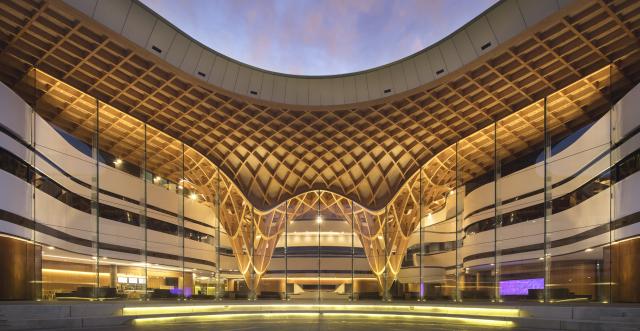
Planet Ark are continuing their “Make It Wood” campaign urging people around the world to look for responsibly sourced wood and to adopt Wood Encouragement Policies.
The group’s Make It Wood campaign manager David Rowlinson said to date, there were two Local Government Associations, two states (Tasmania and Western Australia) and eighteen local councils that hae adopted formal WEPs in Australia
“A Wood Encouragement Policy generally requires responsibly sourced wood to be considered, where feasible, as the primary construction material in all new-build and refurbishment projects,” he said.
“As such a policy does not mandate the use of timber, but rather seeks to ensure that wood is at least considered as the primary structural component in these buildings.”
David provided a couple of recent international examples “which will hopefully provide further incentives for councils and governments in Australia”.
2020 – France: sustainability law that aims to ensure all new public buildings are built from at least 50 per cent timber
“In February 2020 the French government announced plans for a sustainability law that will ensure all new public buildings are built from at least 50 per cent timber or other natural materials,” he said.
“The measure will be implemented by 2022 and affect all public buildings financed by the French state.
“This follows the introduction of a law encouraging the use of bio-based materials for the construction of the 2024 Paris Olympics complex, which requires that any building in the development that rises more than eight storeys will be built entirely from timber.”
The proposal aligns with France’s ‘Sustainable City Plan’, launched in 2009, and also President Emmanuel Macron’s drive for the country to be carbon-neutral by 2050.
2020 – New Zealand government low-carbon construction procurement policy
“The New Zealand government low-carbon construction procurement policy was designed to simultaneously deliver strong economic, social, and environmental outcomes for all New Zealand, and is a necessary step in New Zealand’s path to becoming carbon zero by 2050,” David said.
The policy, which was announced in September 2020, requires government agencies to measure and then choose the construction material option with the lowest upfront carbon emissions (embodied carbon), or explain why not.
Deloitte research found the policy could add up to five thousand jobs to the NZ timber and forestry sector, increase log processing by 1.7 million tonnes annually, sequester 918,000 tonnes of CO2 annually, and result in a NZ$500 million annual balance of payments improvement by exporting high value green products and importing less climate polluting steel and concrete.
So why is wood so good?
“Building and construction accounts for about 40 per cent of global greenhouse gas emissions,” he said.
“Using wood as a construction material actually helps to mitigate climate change.”
“Here’s why: Wood is the only major building material that is renewable. In addition, as trees grow they absorb carbon dioxide (trees grow from the air, not from the ground!). Consequently about half of the dry weight of wood is carbon – so-called biogenic carbon – which is stored for as long as the building exists.”
Timber consumes minimal energy in its production – so-called embodied carbon – so it can be used as a low-emission substitute for materials that require larger amounts of fossil fuels to be produced, such as concrete and steel. (Concrete and steel are each responsible for about 7-8 per cent of global greenhouse gas emissions.)
Make sure it’s certified
“Of course, a key requirement is to use certified timber, sourced from either native forests or plantations,” David explained.
“Forest certification has developed as a way of demonstrating the implementation of sustainable forest management practices. To enable a forest to be certified as being sustainably managed, an audit is undertaken by an independent, third party certification body. The audit assesses the forest management practices of a forest manager or owner against the standard for certification.”
He said certification ensures that when a tree is harvested another is planted in its place. Well over 95 per cent of Australian plantations and state forests are certified, and the significant majority of the wood used in the construction sector has chain-of-custody certification.
More Information on WEPs
For more information on WEPs please contact David Rowlinson, Planet Ark Make It Wood campaign manager, at david@planetark.org or 0400 474 412.