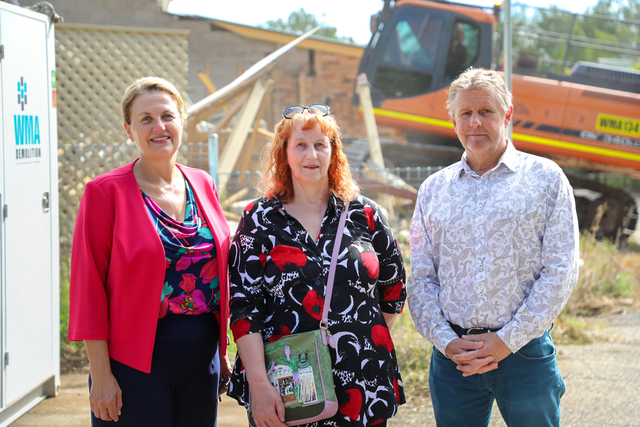
An interview with Jane Trotter, General Manager Corporate and Community Services, City of Burnside, South Australia
With the future of Local Government set to hold a number of challenges, namely climate change and financial sustainability, the City of Burnside’s General Manager Corporate Communications and LGMA National Board Member, Jane Trotter, said good managers must remain consistent in their approach, lead by example and take responsibility for their actions.
“They should set clear direction and support their staff in achieving goals,” she said.
“It is important to be approachable and empathetic, as well as having the ability to make the hard decisions when necessary.”
She said that financial sustainability will continue to challenge councils into the future.
“Councils are recognising the significance of their longterm infrastructure commitments as they gain a more sophisticated understanding of the true, useful life and corresponding depreciation of their major assets,” Jane Trotter said.
“It is essential that councils have robust longterm financial plans so that they can ensure long term sustainability for the community.
“It is also important for councils to engage meaningfully with the community so that they understand the issues and provide informed feedback.”
Jane Trotter said community engagement has always been a challenge for councils to get right.
“We should be looking at new methods to gain more representative feedback from a broader cross section of our communities,” she said.
“The City of Burnside, in partnership with the City of Tea Tree Gully and the Ehrenberg Bass Institute from the University of SA, has initiated an Online Community Panel for engaging with the community.
“The Burnside Panel now has over 750 members, and we engage with these residents via online surveys on issues ranging from consultation on our budget, general satisfaction with Council services, and hot issues such as the potential sale of an iconic community building.
“This Panel has been tested and validated by the University as being as representative as a random telephone survey, and it is much more cost effective.
“We hope to roll this out to councils across South Australia, so that we can share surveys and undertake benchmarking.”
Jane said that resource sharing of all kinds will be an important part of the way Councils will do business in the future.
“When we get it right, it can have many benefits, including cost efficiencies and the ability to access scarce resources,” she said.
The City of Burnside is part of a group of councils called the Eastern Region Alliance. These councils are looking at a range of opportunities for resource sharing across a broad spectrum of functions.
As an example, members of the group currently share a senior rates officer, which enables smaller councils to access a resource that they might not otherwise be able to afford, as experienced rates officers are in short supply.
It also provides opportunities for knowledge sharing and upskilling of other officers across the participating councils.
Jane Trotter said that as well as affecting the environment in which we live, climate change will also have a significant impact on council business practices.
“Efficient energy usage makes good business sense, and can provide councils and the community with the opportunity to secure significant cost savings, while reducing greenhouse emissions,” she said.
“Efficient energy usage can be achieved simply through behaviour change mechanisms, such as ‘switch off lights’ campaigns or installation of energy efficient initiatives at council owned facilities. These include energy efficient lighting, office equipment and building upgrades, as well as natural ventilation and installation of building management systems to control air conditioning.”
She said that emissions trading, which is now set to commence in 2011, will have a number of implications for Local Government, as well as some opportunities.
She said the key elements that will affect Local Government include waste management, street/public lighting, and renewable energy generation and offsets. The cost burden will differ between councils depending upon a particular council’s mix of services, policy decisions and financial circumstances.
“The accumulated costs of the Carbon Pollution Reduction Scheme on Local Government operations may impact negatively on councils’ ability to provide essential services, and may result in higher than usual rate increases for some councils,” she said.
“Emissions intensive goods and services are likely to be more expensive, which will result in increased energy costs, due to the fact that councils are significant users of electricity, primarily for the purposes of public lighting.
“It is also likely that private contractors engaged by councils will pass on any costs incurred under the scheme to council.”