Our environmental management feature in this edition highlights a variety of projects and initiatives showing the proactive stance numerous councils are taking to protect the planet now and for future generations.
As one of many examples, the City of Salisbury in South Australia has been a leader in stormwater capture and reuse for over
15 years. Speaking at the recent Local Government Managers Australia National Congress, Salisbury CEO, Stephen Hains, said that Local Government has a central role to play in moving towards greater sustainability.
Pointing to the water crisis in south east Australia, he said that South Australia has relied on the Murray River for many years. With 85 per cent of water taken for agriculture and urban use and inflows to the Murray now down to 20 per cent, the Coorong lakes are severely threatened by acid soils, not to mention the impact low flows are having on many regional centres and the two million people that currently live in the Murray Darling basin.
As far as urban water is concerned, he said that it is vital we move to become ‘water sensitive cities’.
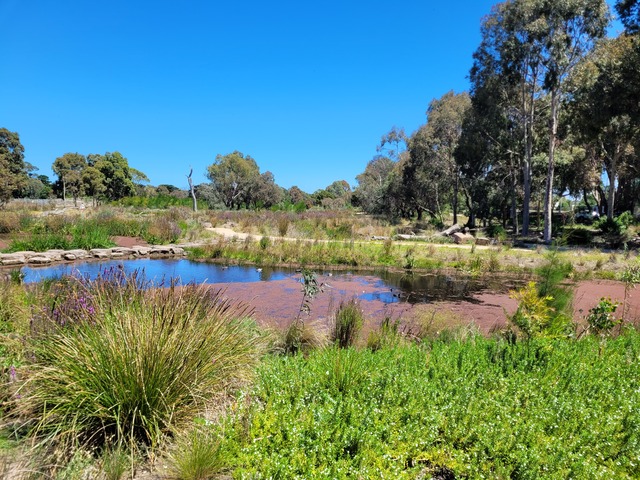
From what started as a project to stop stormwater runoff polluting fish breeding grounds at Barker Inlet and the Port River Estuary, Salisbury City now not only captures and removes pollutants from stormwater using biological wetland filtration but is storing the cleansed water for use on its parks and recreation reserves, a well as selling surplus supplies to local industries.
Stephen Hains said that while Adelaide is the driest capital city in Australia more water flows off its streets and down drains than what the city actually consumes. A staggering 90 per cent of water Adelaide takes out of the Murray is flushed down toilets and used on gardens!
With little rainfall for nine moths of the year, he said storage is vital. Salisbury pumps filtered water from its wetland retaining basins and stores it in deep underground aquifers.
A local wool scouring industry requiring large quantities of water had considered moving elsewhere. With Council in a position to be able to sell its surplus water – at half the cost and of a better quality – this has saved hundreds of local jobs.
Currently Salisbury is capturing just five gigalitres of its estimated
33 gigalitres of stormwater. Over the next five years it plans to increase this to 14 gigalitres.
It is also looking at retrofitting the whole city with a secondary water supply pipeline for gardens and toilets. The cost of this infrastructure would be passed on to consumers at a reasonable rate, with Council expecting a positive cashflow within seven years, including full costing on replacement and depreciation.
All its new residential subdivisions must have the dual system installed. This is cost neutral for developers as it removes the requirement for a rainwater tank costing $3,000 per household.
Stephen Hains said that to become water sensitive cities we must seriously consider ‘fit for purpose water’. Households need very little potable (drinkable standard) water yet tonnes of perfectly good, reusable water runs off our roofs and streets and down drains.
He is correct when he says that Local Government is in a unique position to drive change agenda using local solutions rather than regional or national solutions. As such the innovation and creativity demonstrated by Local Government is not so evident across our other spheres of government.