As part of the research undertaken in Phase One of the Community Harmony Project, Dr Amanda Wise and the Centre for Research on Social
Inclusion undertook a pilot project with Ashfield Municipal Council in
New South Wales. The program aimed to understand the everyday causes of local intercultural tensions in different types of suburbs. A series of intervention strategies were tested, with a special focus on Ashfield’s multicultural shopping precinct and town centre interethnic relations.
Located six kilometres west of Sydney CBD, Ashfield is one of the most culturally diverse municipalities in Australia, with 51 per cent of its population born overseas. Of the 36 per cent of people born in non English speaking countries, the largest group are Chinese, numbering just under 3,000.
Amanda Wise said many of the shopkeepers on the main street of Ashfield are also Chinese and her research found that elderly people from different cultural backgrounds were finding it difficult to adapt to this.
“We found that age and social isolation were key factors feeding racism and interethnic discomfort amongst Anglo Celtic seniors elderly and there was a lack of opportunity for ethnically different local residents to get to know one another,” she said. “Cultural differences in manners played a large role in producing tension between groups and a lack of language skills among new groups created a major barrier to communication and interethnic exchange.”
Amanda Wise said that shopkeepers play an important role in creating a sense of community in their local area and that many long term residents missed the neighbourhood support provided by local shopkeepers they could interact with.
“Good local shops make an area feel like ‘home’ to people who live in the suburb,” she said. “These shops have a special role and can help make a harmonious neighbourhood by being well presented, tidy, friendly and welcoming to all residents.
“Anglo Celtic seniors also felt that the celebration of multiculturalism locally equalled a devaluing of their historical contribution to the area. They felt a sense of symbolic exclusion, and there were few places in the suburb they felt they belonged to. They were deeply affected by the speed of change to the local landscape, in particular in relation to shops.”
Amanda Wise said that the Anglo Celtic seniors felt they were expected to do all the accommodating, both to change personally, and accept a wholesale change in their familiar neighbourhood landscape. In turn, they felt that it was not racist to want signage with both English and Chinese translations and for shop assistants to be able to speak some English as well as Chinese.
Through the local Chinese Chamber of Commerce, the Chinese business community were partners throughout the process, advising on their needs and coming up with ideas on how they might impove things. They were particularly interested in increasing their business by learning how to attract new, non Chinese customers. Therefore, the Pilot program assisted shopkeepers to be more welcoming to other backgrounds. A range of initiatives were introduced, including cross cultural visits to restaurants and seniors homes, capacity building around small business civic citizenship among shopkeepers and a Community Harmony residents working group. These initiatives were all underpinned by a Mandarin-Shanghainese speaking community liaison worker, whose job was to build relationships with Chinese shopkeepers in the area.
A Shopkeeper Information Kit was also developed to assist with these initiatives.
In October 2005, Ashfield’s Chinese shopkeepers were invited to a consultation forum. Amanda Wise said one of the issues that emerged from this consultation was that, while shopkeepers were quite willing to develop good relationships with, and make their shops more welcoming to the wider community, many did not have the information on how to go about doing this.
“Many were also unsure about who to contact at Council to get answers to their questions with regard to running their businesses,” she said. “For this reason, it was agreed that an information kit would be a helpful start in addressing these issues. This kit has three main purposes. Firstly, it aims to provide the shopkeeper guidance on how they can be involved in improving community harmony in Ashfield as a shopkeeper. “Secondly, it provides useful tips on how to improve their business, and thirdly, it provides a list of useful contacts and resources. Tips include things like reducing signage to avoid clutter, and the importance of having English and Chinese writing on all signs so that both cultures feel welcome. Emphasis was also placed on the importance of good quality design on signage.”
Another important aspect of the kit was the section on ‘small business citizenship’, which featured advice on how local shops can get more involved in the local community through supporting local issues such as school fundraising.
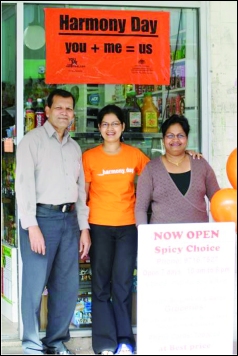
In addition to the distribution of the Shopkeeper’s Kit, a ‘Welcome Shops Open Day’ was held to coincide with Harmony Day. The day aimed to encourage a wide cross section of Ashfield residents, especially the Anglo Celtic seniors, to discover and explore Ashfield’s shops and get to know local shopkeepers.
Macquarie University Chinese speaking interpreting students paired up with a shop and shopkeeper on the day to assist in encouraging visitors into the shop, to translate when needed and to stimulate shopkeeper/visitor interaction.
The town plaza had a fair like set up, with street performers and a wandering minstrel roaming the main road to entice pedestrians into shops. Balloons and decorations were also used on each shop to create a festive, street market like atmosphere.
A souvenir booklet aimed at reproducing a sense of narrative belonging to the local streetscape was also distributed. It featured pictures and stories about local shopkeepers – past and present – to give non Chinese residents an opportunity to get to know more about them as people. There was also a large format poster display in the town square featuring characters from the early days of Ashfield until today, each of whom had an ‘intercultural’ aspect to their life story.
Among a number of new initiatives stemming from the project, Ashfield Council has initiated an annual ‘Welcome Shops’ award, with prizes for best overall shopfront and most improved shopfront.