The National Road Safety Strategy 2001–2010 recognises that road safety for Indigenous people is a particular concern. The estimated road death rate for the indigenous population is about three times higher than that of the non indigenous population. The National Road Safety Action Plan for 2005 and 2006 calls for local consultation and action strategies to identify and put in place local initiatives to improve road safety outcomes for Indigenous people. These local initiatives will complement broader road safety measures in the Action Plan that aim to improve road safety for all Australians.
The Action Plan lists the development of an Internet based system to share information on Indigenous road safety initiatives as a specific priority. A number of jurisdictions have agreed to contribute to this project. The Western Australian Office of Road Safety is the lead agency and is managing a consultancy to develop the system.
The role of the Australian Transport Safety Bureau
The Australian Transport Safety Bureau (ATSB) supports continued collaboration among jurisdictions on Indigenous road safety issues by:
- funding a study to examine current databases and research and identify successful indigenous road safety initiatives. An earlier report, Australian Indigenous Road Safety prepared by ARRB Transport Research Ltd, is available on the ATSB website at www.atsb.gov.au/road/research/ indigenous.cfm
- contributing funding to assist the marketing of a road safety video for use in Indigenous communities, titled Corrugations to Highways. Copies are available free of charge through the ATSB website at www.atsb.gov.au/public/catalog.cfm
- contributing funding to develop an Internet based information resource on Indigenous road safety
- funding and providing administrative support for indigenous road safety forums in November 1999, June 2002, and September 2004
- chairing an inter jurisdictional Indigenous road safety working group to monitor and help implement the recommended actions from the 2004 Indigenous Road Safety Forum.
The 2004 Indigenous Road Safety Forum
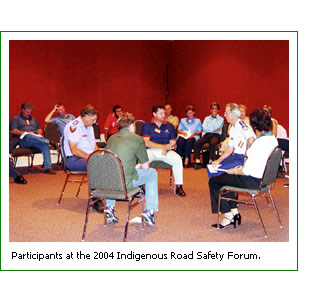
The Australian Transport Safety Bureau (ATSB), with assistance from the Northern Territory Department of Infrastructure and Planning, convened an indigenous road safety forum in Alice Springs on 27 and 28 September 2004. The forum aimed to enhance and build on existing strategies and initiatives to promote Indigenous road safety. It also provided a resource sharing and networking opportunity to help empower communities to put in place practical solutions to indigenous road safety problems.
The agencies who set up the Queensland Safe4Life drivers’ licensing project told their story at the forum.
Over 60 delegates attended the forum in Alice Springs. They included representatives from Federal, State and Northern Territory transport agencies; health, safety, corrective services and sport and cultural affairs agencies, including the Alice Springs Indigenous Coordination Centre; driver training schools; police; motorist associations; community organisations; Local Government; and local Aboriginal elders. The cultural affairs manager of the New Zealand Land Transport Safety Authority provided perspectives on successful measures to improve the road safety of Indigenous people in New Zealand.
Other presentations included: communication techniques; availability of statistics; government, police and community education programmes and other countermeasures; injury prevention plans by the health sector; a whole of government approach through Indigenous Coordination Centres; Local Government countermeasures; licensing programmes; and development of a national Internet-based information sharing programme dedicated to indigenous road safety.
Priority issues
The issues identified by the forum as requiring immediate attention were:
- inconsistent and incomplete statistical data on indigenous fatality and injury rates
- low levels of licensed driving
- low seat belt wearing rates among indigenous drivers and passengers
- unsafe consumption of alcohol by drivers and pedestrians
- need to share information on indigenous road safety among key government bodies and stakeholders
- need to involve local communities when developing countermeasure programmes
- inadequate road infrastructure.
Recommended actions
A working group of stakeholders met at the conclusion of the forum to analyse the issues raised and recommended a list of actions. The recommended actions, shown below, are to be monitored through a twice yearly teleconference of the working group and at the next forum.
- provide information on forum outcomes to key stakeholders and place information on the ATSB website
- submit a paper to the next meeting of the Standing Committee on Transport recommending that Ministers of the Australian Transport Council be informed of forum outcomes
- examine the feasibility of collecting improved and nationally consistent data on indigenous road trauma
- implement changes and monitor progress in the following key areas: improved data collection; increased licensing; increased seat belt wearing, including child restraints; reduction in road trauma involving alcohol; improved infrastructure at high risk locations; and decrease in pedestrian risk
- recognise the need to involve local communities when developing programs that target indigenous road safety
- explore how links can be developed with other areas such as health and Indigenous Coordination Centres
- explore the availability of indigenous community language resources and make efforts to share these resources
- support the development of the Internet information sharing project coordinated by Western Australia and, when finalised, widely advertise its availability
- consider including specific funding in black spot programmes to improve indigenous road safety
- examine possibilities for updating some information in the report Australian Indigenous Road Safety prepared by ARRB Transport Research Ltd.
A CD record of proceedings from the forum was produced which includes an audio recording of the presentation and copies of PowerPoint slides, photographs and the recommended actions.
Developments
Transport Ministers were informed of the recommended actions at the meeting of the Australian Transport Council on 19 November 2004. The Working Group met by teleconference on 26 May 2004 to share information on progress against these actions and to facilitate national coordination where necessary.
More information
More information on Indigenous road safety, including a copy of the CD record of the 2004 forum proceedings, is available on the Australian Transport Safety Bureau website at www.atsb.gov.au/road/indigenous.cfm or by contacting Annette Bartlett on (02) 6274 7131 or annette.bartlett@atsb.gov.au.