The 2005–06 State of the Regions Report has concluded that expanding broadband access in regional Australia will significantly boost regions. The 2005–06 report was released at the Regional Cooperation and Development Forum, a full day event that kicked off the 12th National General Assembly of Local Government staged in Canberra from 7–10 November.
Prepared for the Australian Local Government Association by National Economics and sponsored by Jardine Lloyd Thompson, State of the Regions Report is a comprehensive stock take of the economic and social wellbeing of Australia’s 64 regions and their prospects for economic development and employment growth.
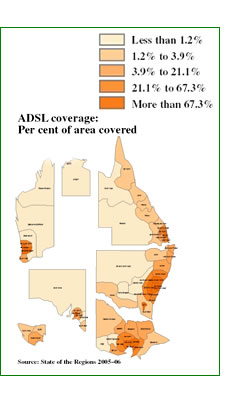
The 2005–06 report provides clear evidence that regional Australia is under performing in terms of its potential use of information and communication technology with negative implications for exports. But investment of as little as $3 billion to extend broadband cover could create more than 10,000 jobs and provide an annual benefit to the nation of more than $920 million a year, or more than $27 billion over 30 years (in 2004 dollar terms).
ALGA President, Councillor Paul Bell, said that the report clearly demonstrates the benefit of well targeted investment by government and others in expanding broadband.
“We must get on with the task of building our nation through major investment in improving and extending broadband,” he said. “The regions that need the most help will gain the most benefit. The report shows that a strategy of fibre optic ‘deepening’ to extend ADSL cover to most of the remaining unenabled ADSL exchanges in Australia could cost as little as $3 billion. Given the benefits from exports estimated in the report, this would unlock an internal rate of return to the nation in terms of increased gross product, of 20 per cent a year. And this is a conservative estimate.”
Deputy Prime Minister and Minister for Trade, Mark Vaile, concurs with this view. He said that with technology moving so fast, if broadband is available for businesses huge gains in productivity are to be had, and hence he believes the projections of gains in the report are underestimated.
The State of the Regions Report also revealed our top regions. It assessed Australian regions against ten specific measures to determine their population sustainability. For many Australian regions, the ability to maintain and grow populations is a critical factor affecting local economies and service provision. So what are the key components of population sustainability and which regions are performing well?
Key issues include the ageing of the population, consistency of population growth, fertility rates, the dominance of regional centres, family migration and demographic stress. Report co author, Dr Craig Shepherd, said many regions with significant and sustained population growth are not overly worried about population sustainability.
“However, there is a larger number of other regions for which the components of population change, births, deaths and migration are pointing to a much less secure population size which in turn places significant pressure on local economies and service provision,” he said.
Commencing with the best performer, the top ten regions that are coping well with demographic stress are the Sunshine Coast, QLD; Peel-South West, WA; Pilbara-Kimberley, WA; Perth Outer North, WA; Melbourne Inner, VIC; Gold Coast, QLD; Sydney Inner West, NSW; Brisbane North, QLD; Central Coast, NSW; and Sydney Outer South West, NSW.
“In particular, demographic stress is a truly powerful measure of population sustainability,” Dr Shepherd said. “It is a measure based on the level of out migration and growth rates in the 15–55 year cohort. Regions that have experienced high levels of out migration, yet have been able to grow their population of 15 to 55 year olds, are in an excellent position to grow or at least sustain their population into the future.
“When all ten indicators are combined, a population sustainability score is achieved. The majority of Local Government areas that do well are in metropolitan regions, where employment prospects for young people are stronger, amenities and service provision are available and future prospects are better than average.
“These regions have an enviable mix of in migration, relatively low levels of ageing, growth in fertility rates, higher than average levels of employment and strong locality dominance.” At the other end of the spectrum, the bottom 12 regions are those most likely to struggle to retain their current populations.
“These regions typically have low in migration, low fertility, an older than average population and fewer dominant localities,” Dr Shepherd said.
Population sustainability rankings and scores for all 64 Australian regions can be found in this year’s report. The State of the Regions Report can be accessed online via the ALGA website at www.alga.asn.au