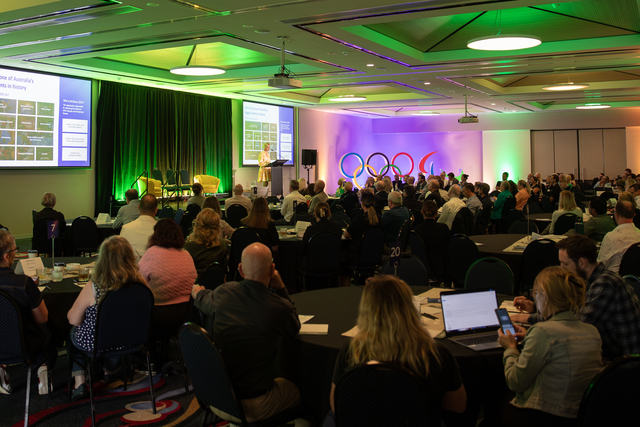
Australian of the year, scientist, explorer and national spokesperson on climate change, Professor Tim Flannery, told delegates that he had been looking forward to be speaking to them at the National General Assembly.
“It is you who are already doing much of the heavy lifting,” he said. “Around the world Mayors and Councillors are global leaders and it is your closeness to the community that is the key. Your services and programs are delivering large reductions in Greenhouse gases, and you are also working with your local businesses to tackle this issue.”
Tim Flannery said that Australia is wealthy in alternative energy sources and that many new enterprises will start small and then grow in local areas. He said air pollution leading to climate change is a global problem.
“To a large extent our atmosphere is taken for granted,” he said. “In mass, our atmosphere is one five hundreth the size of our oceans. The oceans are large enough to be forgiving of human activity but this is not so with our atmosphere. There is a critical balance between life and our atmosphere. If we change the atmosphere we change life on this planet.”
He outlined the three major consequences human activity has had on the atmosphere in the past 30 years. These include acid rain, the hole in the ozone layer and increasing Greenhouse gas emissions. He said in the 1980s acid rain from burning coal with high sulphur levels resulted in trees dying and extensive damage to waterways, particularly in Northern Europe. In this case the lowering of levels and capture of sulphur from flues saw the earth quickly reheal itself.
The hole in the ozone layer from chlorofluorocarbons (CFCs) destroying this protective layer of gases would greatly increase cases of skin cancer, and its adverse effects on crops cause mass starvation. Reducing the use of CFCs has decreased the hole but this is a clear warning of how our inventiveness can lead to unintended consequences and threaten our very existence.
Since the late 1980s the recognition of the effects of Greenhouse gases – particularly CO2 – saw scientists warning that an increase in these gases to 450 parts per million would lead to dangerous climate change.
“At the start of the industrial revolution this level was 300 parts per million,” Tim Flannery said. “However by mid 2005 we had already crossed over into the dangerous level reaching 455 parts per million. We must reduce our CO2 levels to ensure our future. By 2050 emission reduction needs to be 80 per cent and
40 years is not a long time to achieve this.
“A carbon free economy can’t be burning coal or natural gas. We need to be using alternatives now.”
He told delegates that the election of the Rudd Government sees the end of 11 years of inaction. Kyoto will be ratified, leaving the USA the only nation not signed up to this protocol. He said the way forward and opportunities ahead include clean coal technology, geothermal energy and harvesting the energy of the sun on a large scale.
“Australia’s renewable energy sources provide a huge potential and we now have the Government to get things done,” Professor Flannery said. “The next
40 years will be a new global revolution with many things to fear but also huge opportunities. In the 21st century there will still be the social injustices and wars, but sustainability will be the number one issue. We need to find ways for nine billion people – all aspiring to our standard of living – to live on this planet with dignity and sustainability.
“Local Government has an integral part to play in meeting this challenge, local people look to you for leadership because you are closest to them and able to take on this vital role.”