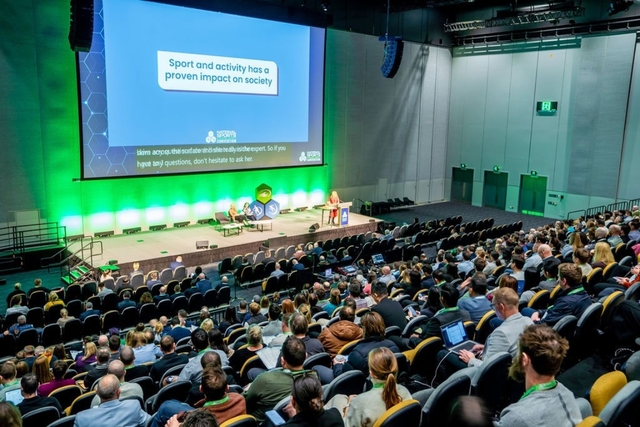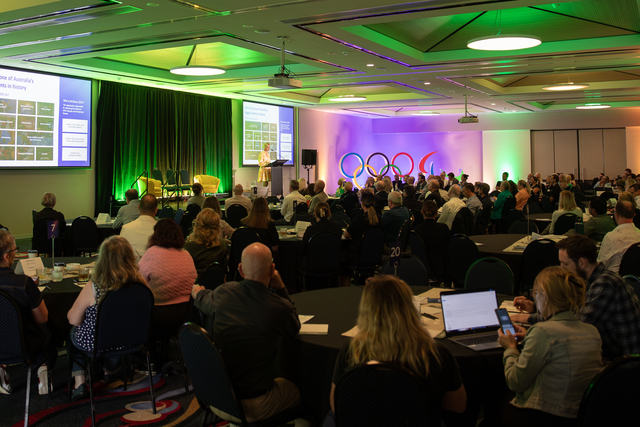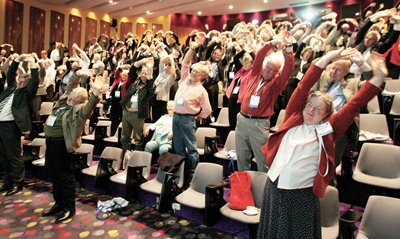
Staged in Hobart from 10 to 12 June, the Local Government Association of Tasmania (LGAT) Annual Conference brought together a range of keynote speakers and workshops centred around the theme of ‘Community Conversations: Striving for More’.
Acting LGAT President, Councillor Barry Easther, chaired the conference following the recent election of Mike Gaffney to the Tasmanian Legislative Council.
Director of Creating Communities Australia, Allan Tranter, said Local Government is in a prime position to transform its communities and economies to not only cope with the future, but to create outcomes that are beyond normal. However, he said that the community needs to shoulder the responsibility with their councils.
“Local Government is now doing more of the things communities and neighbourhoods used to do for each other, but it cannot afford to continue like this,” he said.
“Email and the internet have removed personal, face to face communication, and many other constraints have been removed along the way. Not being reliant on our neighbourhoods removes the constraint of community.”
He referred to what he likes to call the trend of ‘afluenza’.
“People think that they are happier when they have more ‘stuff’,” he said. “So they borrow more money and work more to get more stuff, leaving less time for family, friends and neighbours. It is time to pause and think about what is really important.”
Allan Tranter said Local Government is best placed to change the conversation.
“It’s about having a different kind of conversation – and I think Local Government could lead it – in getting people to take responsibility for their own lives, in rebuilding the fabric of their community so they are not dependent on an external body to do it for them,” he said.
Tasmanian Minister for Local Government, Jim Cox, told delegates that he has seen a great improvement in the relationship between the Tasmanian Government and Local Government in recent years.
He said this excellent working relationship is demonstrated through a commitment to 46 partnership programs over the last decade, which have produced real outcomes for communities across the State. Fourteen more agreements are currently being implemented and a further seven are expected to be signed off in 2009/10.
The Minister said that while a number of Tasmanian councils do need to take action to improve, this does not mean councils have to amalgamate.
“They must look at where they need to be in years to come, or it will be a detriment to their council in the future,” he said. “The State Government does not support and will not pursue forced amalgamation. The people who know the best interests of communities are those in it.”
Jim Cox said if amalgamation is not desired, there are still many ways councils can work together at a regional level, for example through resource sharing and regional partnerships.
In his address, ‘The High Performance Team: Your Culture – Your Success’, motivational speaker Graeme Joy said the tougher it gets, the better people perform.
“We must be willing to push our goals to achieve our vision,” he said.
Graeme Joy said the key to quality in an organisation lies not in the success and achievement of individuals, but in the success of a high performance team.
He said a high performance team is a group of people with a common vision and the promise of a shared reward at the end.
“Each team member is equally important, as a high performance team should maximise the best attributes of each individual – everyone is working off and with each other,” he said.
“They are more efficient, productive, they are a spawning ground for creativity, they promote harmony in the workplace and they are the quality driver in all business.
“Best of all, high performance teams achieve results faster.
“To ignore the concept of the high performance team is to ignore the future of successful business.”
He said it is crucial to select the right people for the team.
“This is the most important goal,” he said. “It determines whether we will win.
“The essential characteristics of a high performance team are a shared vision, excellent communication skills, a common drive, highly developed conflict resolution and organisational skills and an ability to set goals and achieve them.
“No group of people is naturally equipped with this plethora of business virtues, but these attributes can be instilled through training.”