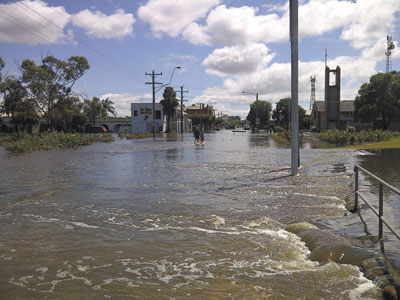
Local governments are facing the aftermath of natural disasters right across Australia, from the destruction wreaked by cyclones in Port Hedland to seemingly endless floods across Queensland, Victoria and NSW. Coping with the impact of these events is increasingly placing councils in the hot seat in terms of recovery, planning for disasters and mitigating their effects.
Most local governments agree that the cost of recovery strains already limited funds and services; similarly, most agree that there needs to be concerted support from State and Federal Governments in the wake of disasters. In the Australian Local Government Association’s (ALGA) 2011—2012 Budget Submission to the Federal Government disaster recovery and mitigation was raised as a critical national issue, with the report arguing for “measures that enabled councils to undertake climate change risk management assessment studies, build flood levees and other urgent and strategic infrastructure projects in high-risk areas.”
Rod Brown, our Canberra expert on Federal issues, says, “The delays and buck-passing post the Victorian bushfires and the Queensland floods are symptomatic of a deep-seated lack of organisation and leadership. The ALGA should, if it isn’t already, be lobbying the Commonwealth and State governments to establish a Disaster Fund.”
Most disaster affected regions face the double burden of recovery and then the necessity to look ahead to mitigation against further events. Still reeling from the 2010 floods, Roma and Mitchell in Queensland are now coping with the aftermath of another deluge in late March. A report into the region’s hydrology, funded by the State Government, recommends $15 million of work on Roma’s levee banks, drains, house-raising and other infrastructure. Mayor Robert Loughnan of Maranoa Regional Council says that his job, along with overseeing the current recovery process, involves “keeping the political focus on the cost of future mitigation”.
For many regions, planning for future events is overtaken by immediate concerns, such as securing contractors for the clean up. Mayor of the Town of Port Hedland, Kelly Howlett, says that the aftermath of cyclones “puts a considerable strain on the local government authority”. Following a cyclone, Port Hedland has had to cope with green waste removal, damage to streets and footpaths, and a surge in mosquito populations. Securing local contractors to tackle the extra work has proven difficult.
“In the aftermath of Cyclone Heidi (January 2012), due to timing and the current growth of the resources industry, it was extremely difficult, to the point of nearly impossible, to hire any local contractors to assist with the extra workload. This caused considerable stress in the community, particularly when the forecast for a period after Cyclone Heidi showed that another system (Cyclone Lua in March) was potentially going to affect Port Hedland again.”
Disasters impact on communities and their local governments for years after the event as the damage, recovery and mitigation bill cannot be assessed until extensive reports have been completed. And, while funds are available through the Natural Disaster Relief and Recovery Arrangements (NDRRA), accessing the joint State and Federal fund is by no means straightforward.
Bundaberg Regional Council Mayor, Lorraine Pyefinch has overseen the recovery from two major floods in December 2010 and January 2011. Cr Pyefinch comments that “The NDRRA program has been made much more complicated since 2010 and it has taken the best part of a year to go through the painstaking process of preparing the submissions. The new auditing requirements have cost Council in the region of $1 million in additional costs.”
There’s no doubt that local governments, with the support of the ALGA, need to keep the pressure on State and Federal governments to make recovery, assessment and mitigation less burdensome for local councils. In relation to the recent, severe floods in and around Nathalia and Numurkah in Victoria, Mayor of Moira Shire Council Alex Monk says, “It is not viable for local government to bear the financial burden of recovering from a natural disaster without it having an adverse impact on the delivery of key council services and, ultimately, its communities, during a period when people are already vulnerable. It is important to maintain an open dialogue between local, State and Federal governments in the aftermath of any natural disaster.”