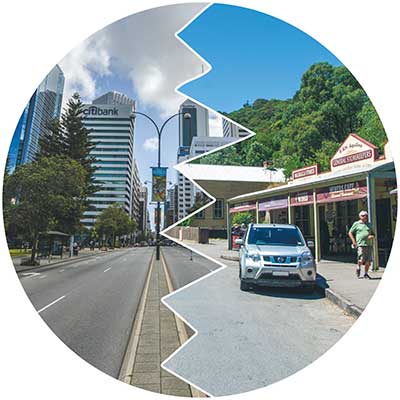
Australian local governments are facing amalgamations as a solution to economic insecurity.
Councils in New South Wales are currently in the process of justifying their financial security through the Fit for the Future reforms.
President of Local Government New South Wales (LGNSW) Councillor Keith Rhoades said that LGNSW was committed to assisting councils through the proposal submission process, but is strongly opposed to forced amalgamations.
“It’s imperative that the NSW Government recognises the need to reform the financial framework in which councils operate too, including abolishing rate pegging and the inequitable rate exemptions that currently exist.
“Funding relationships with the Commonwealth need to be strengthened.
“If councils are to be financially sustainable in the future, it is essential to ‘Fix the Funding First’.”
Local government in Western Australia underwent a similar review process, and will see forced amalgamations completed on July 1, 2015.
South Ward Coucillor for the City of Subiaco Hugh Richardson has been investigating amalgamations for two years, and does not support the measures.
The City of Subiaco will be merged with the Town of Cambridge.
Councillor Richardson said that the forced amalgamations would result in a less cohesive community and higher rates for City of Subiaco residents.
Cr Richardson also stated that a council’s size does not directly relate
to sustainability.
“There is not doubt in my mind that most councils are sustainable.
“Historically, forced amalgamations do not work.”
Tasmanian councils are currently investigating the option of voluntary amalgamations should a merger be in the interest of ratepayers, improve the level of services for communities, maintain local representation and strengthen the financial status of the councils.
The Local Government Association of Tasmania (LGAT) has released their submission to the 2015-16 Tasmanian state Budget, requesting consultation and funding for the costs of voluntary amalgamations including consultant reports, feasibility studies and community consultation.
LGAT President Mayor Barry Jarvis has also addressed voluntary amalgamations in his President’s Comment article in this edition of LG Focus.
New South Wales Premier Mike Baird claimed at the announcement of the ‘Fit for the Future’ support package that New South Wales councils were losing one million dollars per day, and that two thirds of local council were financially in the red.
The information was drawn from the Financial Sustainability of the New South Wales Local Government Sector report conducted by the New South Wales Treasury Corporation.
The report highlighted unsustainable operating deficits, deteriorating sustainability, and despite improvements in asset management, a $1.6 billion maintenance gap over four years.
However Mosman Mayor Councillor Peter Abelson has disputed the findings of the Fit for the Future program in an economic paper examining the financial criteria for amalgamation.
The analysis by Dr Abelson, an economist who has held a Chair in Economics at Macquarie University, and Dr Roselyne Joyeux, an Associate Professor at Macquarie University, shows that there is no relationship between scale (population) and financial sustainability.
Instead it suggests that financial capacity is fundamentally a function of the income of the local community, not of scale.
“The Independent Local Government Review Panel provided no evidence or reference in its report to support their view that larger councils are more financially sustainable than small ones,” Cr Abelson said.
“This paper shows the equation of scale with financial capacity is both baseless and incorrect.
“Small councils can generally achieve similar economies of scale by shared services with other councils or by outsourcing some services to large private providers as has been demonstrated by Mosman Council.”
Cr Abelson said councils have been disadvantaged by the government changing its accounting definition of councils by excluding capital contributions and grants in revenues and by rate pegging that had not allowed for any increase in local council services in more than 10 years.
“In a less regulated environment, many councils could run balanced budgets if they were able to determine their own rates.
“Instead, the NSW government made the rules, the benchmarks and the rate pegs and has now changed the benchmark but not the rate pegs.
“It should not be using the rule change to denigrate the financial capacity of
local councils.
“It is strongly our view that small and medium-sized local councils are the best vehicles for provision of local services and for protection of the environment.”
Several New South Wales councils have already begun announcing their intentions for the reforms, including Warringah Council who have proposed a merger with neighbouring councils Pittwater and Manly.
Warringah Mayor Michael Regan said that a merge would result in better planning and value for ratepayers in the region.
“One Northern Beaches Council would unify the northern beaches, reduce duplication, red tape and operating costs.
“Concerns about loss of local representation are a red herring, as this can be maintained, and even increased, depending on the governance model that
is adopted.”
However not all councils are in support of mergers.
Randwick City Council Mayor Ted Seng said that Randwick already has a balanced budget and remains debt-free.
“Council is operating well and providing high quality services and facilities for
our community.
“Unfortunately, despite Council’s excellent financial and asset management position, the NSW Government wants us to respond to the Independent Local Government Review Panel’s recommendations for ‘scale and capacity’.
“The Independent Review Panel’s final report released in October 2013 recommends an amalgamation with City of Sydney, Woollahra, Waverley and Botany councils, building a ‘global city’ with more than 500,000 residents.
“We don’t support the creation of a global city as we value our Randwick identity, local representation and existing quality services.”