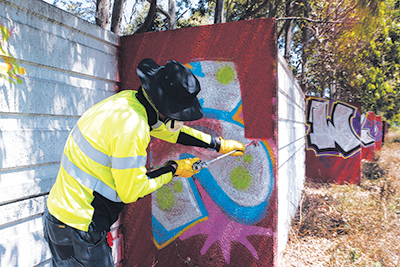
On Sunday 18 October, 2500 volunteers armed with paint and brushes took to the streets of New South Wales for annual Graffiti Removal Day. Participants painted 400 sites and removed an estimated 4000m² of graffiti.
The NSW State Government financially supported the event and about 55 councils were involved in the clean up effort. It is estimated graffiti removal costs across NSW totals more than $100 million each year.
Councillor Mark Sultana has spearheaded the anti-graffiti movement at Coffs Harbour City Council and has participated in Graffiti Removal Day for the last two years.
He said this year’s event in Coffs Harbour involved over 30 volunteers who painted 13 locations, including a pub, lifesaving club, and a State Government building. Many of the sites were being prepared for murals by local artists, a strategy that Cr Sultana said effectively deters tags.
“There seems to be an etiquette between artists, that if someone paints a wall, it gets left alone.”
Cr Sultana said he learnt from last year’s event that graffiti clean up needs to be part of a long-term strategy.
“Last time, about two or three days later, I went back to the sites we painted and they were littered with tags, much worse than before”.
This has led to the push for a larger Graffiti Removal Policy at Coffs Harbour City Council, which will include a tagging hotline and getting the local Lions and Rotary Clubs involved in the operation of a clean up vehicle.
Cr Sultana said rapid removal is important, “you don’t want to leave it up there, it gives kudos to the graffiti vandals”, but he said negotiation is also necessary, “It is important to give the graffiti guys somewhere to do their art.”
The Council is looking to introduce three free walls where people can paint at different levels. “You have to find a happy medium, if you start penalising people too much, you’re just going to create more angst.”
Cultural researcher at the University of Melbourne, Dr Lachlan Macdowall, said that removal day strategies may not be the best solution for councils and a “holistic approach” needs to be adopted.
“Graffiti thrives on walls being cleaned,” he told Local Government Focus.
MacDowall has worked with several councils in inner Melbourne as a consultant about the historical and social value of graffiti. He authored a 350-page report for the City of Melbourne, after a renowned Banksy work was removed by council cleaners, to much public outcry.
Macdowall said the perception of graffiti indicating larger criminal activity is unhelpful and largely inaccurate. “A binary system between graffiti and street art has been created, with positive characteristics attached to street art… and negative attached to graffiti.
“It’s a caricature that’s really unhelpful. It obscures the fact that graffiti and street art are related.”
Street art is now one of the main tourist attractions for international guests to Melbourne, according to Lonely Planet.
MacDowell said councils should “think about where, why and how graffiti is being created… it might be related to frustrations, or more positive things like a desire for expression.”
He urged all councils to think creatively about how to approach the issue, such as reducing a cleaning budget to free up money for other, more innovative projects.
“It’s not just an urban phenomenon. Councils shouldn’t just shrug their shoulders and say ‘it’s a Melbourne thing’”.
Macdowall also noted “a number of councils have begun recognising the connection between street art and tourism”.
In March this year Benalla became the first regional Victorian town to host a dedicated street art festival, Benalla Wall to Wall. World-renowned Melbourne-based artists including Rone and Adnate visited the town for a weekend to paint expansive murals, their work receiving much praise from locals.
As a contrast to this, in September tough new anti-graffiti laws were introduced in Western Australia. Offenders now face a fine of $24,000, or up to two years in jail.
Melville City Council, situated in metropolitan Perth, managed to halve their graffiti clean up bill between 2007 and 2013. Mayor, Councillor Russell Aubrey, said he could understand that the new laws might act as an effective deterrent, but Melville has managed graffiti without the need for such harsh penalties.
Over the stated period, clean up incidents were reduced by 52 percent and the removal bill dropped from $416,046 to $64,226.
Cr Aubrey put the success down to Melville’s implementation of a suite of strategies and working closely with the WA Police. The Council has a Memorandum of Understanding with the police force, in which the two share information and photograph and record all tags before they are cleaned, to build a database.
Other strategies include targeting hot spot areas, introducing urban art projects and concentrating on rapid removal.
The City also has a focus on rehabilitation for offenders said Cr Aubrey, which leads to a low re-offence rate. “What we’ve got to do in local government is be proactive, go the effort, and the cost, and take offenders to justice, but importantly, work with them afterwards.”
The Mayor encouraged neighbouring councils to follow suit, “We recommend councils adopt the whole package”. He said, as graffiti writers “don’t discriminate about council bounds, people spill over from other areas”, it is useful for councils to work in tandem. “The more local governments that adopt the program, the better chance we have,” said Cr Aubrey, “We should work together on this.”