In an environment of fiscal uncertainty for local government, is enterprise the answer?
In 2002, local councils in New South Wales were approached with an offer. Newly-formed telecommunications company, Southern Phone, was asking for a simple $2 investment.
Backed by the federal government’s Networking the Nation scheme, the company was established to sell telecommunication services to regional areas at a competitive rate and, importantly, to allow local municipalities to funnel profits back into their communities.
41 councils signed on as equal shareholders, becoming the sole owners of the company. More than a decade on, these councils are reaping financial rewards.
Bland Shire Council signed up and the partnership has proved immensely valuable for the small area of about 6000 people.
“I don’t think anyone had hugely high expectations,” said Community Relations Officer Craig Sutton of the investment, “but the results have been outstanding.”
Last year the Shire took home a dividend payment of $29,852. Dividends vary across councils; 20 percent comes from an equitably split pool, 80 percent pertains to the number of Southern Phone customers within the local government area. Some council areas have received as much as $480,000 in a year.
Two years ago Southern Phone also introduced an annual grant scheme, offering $25,000 to each shareholder council for community projects.
Mr Sutton said in a time when finances are tough, the grant Bland Shire received alleviated financial pressure and supported small but important projects that would have struggled to receive funding otherwise.
Until recently, the chance for additional councils to buy-in to Southern Phone has not been possible, but due to uncertainty over council amalgamations in NSW, this could potentially change.
As angst over the Financial Assistant Grant indexation freeze continues and rate capping and rate pegging threaten to increase financial pressures, there is much incentive for councils to investigate investments to spur own-source revenue.
Chief Executive Officer of consultancy organisation The Cockatoo Network, Rod Brown, said there is “fertile ground” for councils to consider entering new investment areas, including: environmental management, renewable energy, livestock hubs, border protection, aged care, freight hubs, ferries, airports and ports.
“The scope for local government to move into some of these areas would need to be carefully thought through,” Mr Brown said, “Councils must avoid taking on unprofitable activities that the feds or state governments might want to offload.
“Councils need to think objectively about activities that they truly think they could be good at. They should then explore how to joint venture with other levels of government and the private sector.
“This has three advantages – it spreads the risks, opens up avenues for innovation and collaborative funding, and overcomes the inertia and conservatism often found in bureaucracies.”
Mr Brown said councils should consider joining together to take their ideas forward.
In Victoria, local government collaboration has led to the establishment of Community Chef, an organisation that operates on a socially-minded business model.
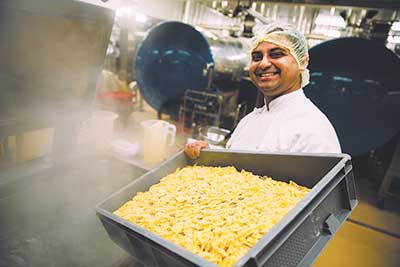
Every day at a world-class kitchen in Melbourne’s north-western suburbs, the Community Chef team prepares 12,000 healthy meals, which are used across the state as part of Meals on Wheels services.
This amounts to one third of Victoria’s entire Meals on Wheels output.
Operating since 2010, the social enterprise was founded by 13 Victorian shareholder councils, and now involves 23 councils across the State. The venture was kick-started by additional investment from State and Federal Government.
The company’s main focus is on returning a ‘social dividend’, but it works on a business-oriented structure and it is hoped surpluses will eventually be delivered to investor councils.
Chief Executive Officer of Community Chef Joe Ciccarone said the business is “cash generative” and “profitability isn’t too far away”, but during the early years the focus has been on growing the organisation.
Initial profits will likely be reinvested back into the business to increase social gains.
As part of its social outlook, the company actively employs people that may struggle to find work otherwise, such as newly-arrived migrants and refugees and those of differing ability. A portion of vegetables is sourced from Karkana, an organisation in Horsham that employs intellectually disabled staff.
Mr Ciccarone said the company is an example of innovative thinking in local government and shows the clear benefits of investing in service-sharing.
“Local governments do a really good job of providing services, but services don’t come for free, so to meet budgetary constraints they need to think differently.”
A similar service-sharing model could be applied to numerous other local government areas, such as road construction, animal shelters, or IT, Mr Ciccarone said.
In April, a report from the Australian Centre for Excellence in Local Government (ACELG) and LG Professionals (then LGMA) praised the social enterprise for its forward-thinking approach and concluded, “The Community Chef model can be adapted and applied in any number of service areas and functions, both within local government and beyond, such as aged care, child care, housing, and youth services.”