Home » Working on a tree change

Working on a tree change

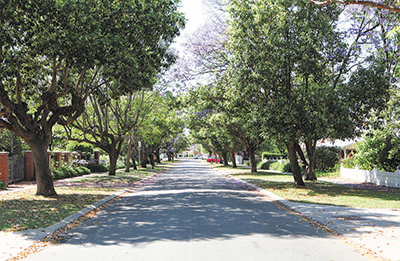
The City of Stirling in Western Australia is working to ensure significant tree canopy is maintained across the expanding city.

Keeping up with the City of Stirling’s growing population and maintaining sufficient tree canopy has become a challenge for Western Australia’s largest local authority.

With a population of more 227,000 residents, the City has become a go-to destination for medium-density redevelopment in its central and eastern suburbs.

The average canopy cover across the City currently sits at around 12.9 per cent and varies from 20.5 per cent to as low as 4.4 per cent across some suburbs. Since 2008, the City has worked actively to increase canopy cover through its Million Trees program.
The program currently adds around 10,000 new trees to public land each year.

In 2014, Council set a target to increase citywide tree canopy cover to an average of 18 per cent by 2030. Aerial canopy surveys conducted annually since 2012 have shown an average canopy loss of 20Ha each year. Two-thirds of this loss occurred on redeveloped residential land. Suburbs with the highest rate of residential redevelopment experienced the most canopy loss.

Council’s Coordinator of Sustainability, Clayton Chipper, said it was forecast that without a reduction in canopy loss on private land it’s unlikely the City could achieve its 18 per cent canopy cover by 2030, and would prove difficult even by 2040.

“The City’s tree planting program is predicted to exhaust all available public land that can accommodate additional trees within a 15 to 20 year timeframe.

“The program alone will not be able to raise canopy cover to the desired 18 per cent,” he said.

In the City of Stirling, like much of WA, it appears that residential redevelopment and residential canopy cover are mutually exclusive outcomes, yet this is not the case in other states where increased housing density and increased canopy cover can coexist.

Council’s Manager City Planning Fraser Henderson said the City’s efforts to improve tree canopy levels included developing an Urban Forest Strategy that could draw on positive interstate examples, tree protection legislation and feedback from the community.    

“Boosting tree canopy levels is a constant challenge for the City, but it’s one that we must tackle for the good of our community.
“The City is working on ways to turn it around, including works currently underway on a Comprehensive Tree Retention Policy that will seek to retain significant trees on development sites,” he said.
With private land an important player in increasing the level of tree canopy across the City, Council recently adopted a Trees and Development Policy requiring the planting of one large tree for each 500m2 or part thereof on new developments.

Digital Editions


  • Together Butchulla Talk

    Together Butchulla Talk

    A new Indigenous book celebrating the Butchulla language and local animals was launched at Hervey Bay Library earlier this month with storytime, language, dance and…

More News

  • A creative future for Kingston

    A creative future for Kingston

    The community has been invited to help shape Kingston’s creative and cultural future. Kingston residents are being invited to help finalise the city’s cultural roadmap, with the Draft Creative and…

  • Tweed residents gunking up wastewater

    Tweed residents gunking up wastewater

    Tweed Shire Council is urging residents to rethink what they flush down the toilet and pour down the drain, after revealing that crews remove around 156 tonnes of rubbish and…

  • In memory of Chris Quilkey

    In memory of Chris Quilkey

    It was with great sadness that we learned that former Blacktown City Deputy Mayor and Councillor Chris Quilkey has passed away. First and foremost, our thoughts are with Chris’s family,…

  • Unit demolished as Ipswich flood recovery continues

    Unit demolished as Ipswich flood recovery continues

    Ipswich Mayor Teresa Harding has welcomed the demolition of Mihi Grove, a flood-hit 42-unit complex in Brassall purchased as part of the Queensland and Australian Government’s Resilient Homes Fund Voluntary…

  • Fraser adopts tree

    Fraser adopts tree

    The Fraser Coast now has an official tree, with Council today adopting the Kauri Pine as a symbol of the region’s culture, history and natural environment. Fraser Coast Mayor George…

  • Council take on much-loved garden

    Council take on much-loved garden

    Glenorchy City Council will take on the administration of the Chigwell Community Garden, securing the future of the much-loved community space and supporting continued shared use by local groups. Glenorchy…

  • Fuel prices hurt country LGAs

    Fuel prices hurt country LGAs

    The fuel crisis is hitting remote, rural and regional communities hard, with farmers, freight carriers, tourism operators and local government all expressing concerns about the lack of supply and the…

  • Navigating grants

    Navigating grants

    How Administrative Complexity Is Eroding One of Local Government’s Most Powerful Tools Local government grants exist to create impact in communities. Yet across the sector, that purpose is increasingly being…

  • Looking to the future

    Looking to the future

    Flinders Lane will be abuzz for two days this month with Townsville Youth Council – supported by Townsville City Council – set to deliver a free festival focused on the…

  • WA leads the way as people to the regions

    WA leads the way as people to the regions

    Ten million people now call regional Australia home, and Western Australia is leading the way with its regional population growing faster than the cities, according to a deep dive into…