By working in collaboration with their communities, councils are helping to drive long-term change in socially disadvantaged areas.
The city of Burnie, in northwest Tasmania, was once known as a paper town. At its peak, the local pulp mill employed 3500 workers and helped the port city become an industrial hub. But business had been winding down since the 1990s and when the mill closed in 2010, the local community took a further economic hit. In 2011, Burnie registered one of the highest levels of youth unemployment in the country and school retention rates were low.
Shortly after the mill closed, Burnie City Council developed its long-term strategic plan, Burnie 2030, and undertook widespread community engagement to identify the key issues that locals wanted addressed. At the heart of this were education and school attendance, health, and employment opportunities for young people.
Council’s Director Community and Economic Development, Rodney Greene, said it was initially daunting for Council to consider taking on more responsibility for complicated social problems.
“At the time it was a bit of an issue for Council, because we’re not health providers or education providers or an employment service, so we weren’t sure exactly what Council’s role was going to be,” Mr Greene said.
But Burnie steamed ahead and investigated how to become more engaged in facilitating social services.
In 2014, the resulting initiative was named Burnie Works and it has since helped deliver several projects that aim to drive long-term socioeconomic changes.
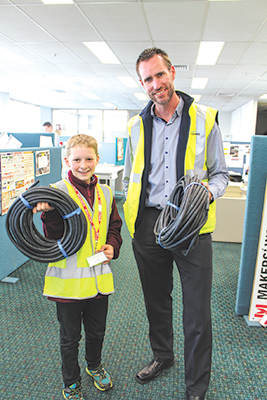
One project, Dream Big, has helped local businesses partner with schools to show Grade 5 students future work opportunities.
Mr Greene said this has involved about 200 children and has encouraged them to be more aspirational in their future goals.
“We’ve had students who have wanted to be marine biologists, so we take them to a salmon hatchery and they get to talk to the marine biologist who helps raise the fish there,” Mr Greene said.
“They can be engineers, painters, hairdressers – they can choose any career. We had [an aspiring] professional wrestler. We couldn’t find a professional wrestler in Tasmania, but we found a martial arts instructor.”
Another pilot project, Everyday Counts, brought together a range of government and non-government agencies to help children of participating families increase school attendance.
An annual local science competition in partnership with University of Tasmania has also proved popular and two winners have gone on to represent Burnie at the Intel Science Fair in the US.
Under the Burnie Works structure, Council facilitates a Local Enabling Group (LEG), which acts as a ‘backbone’ that supports several other working groups to deliver each project. The focus is on the community taking the lead.
A recent study by the University of Technology Sydney’s Centre for Local Government (UTS:CLG) cited Burnie Works as a key example of a successful ‘collective impact framework’ in action.
The Walking With Communities report examines local councils’ ability to encourage autonomous community leadership.
Mr Greene said local governments can go further than just delivering ad-hoc services: “It’s not about governments trying to do things for communities, it’s about communities trying to do things for themselves; councils are a great intermediary to help facilitate that process.”
The report also looked at a neighbourhood renewal project led by Penrith City Council, which is helping to foster local leadership in the suburb of Colyton.
Launched in 2015, the Team Colyton initiative has brought together a group of residents and encouraged them to advocate for and organise events within their own community.
Open-invitation meetings are held monthly and involve a core group of about 15 Colyton residents and representatives from local services.
The group has spearheaded a wide range of projects and has hosted events such as a welcome tour for newly arrived refugees and a popular Christmas Carols evening.
Penrith has been running its neighbourhood renewal program for the past decade, but the Team Colyton approach involves a longer-term commitment to addressing social and economic disadvantage in a specific area.
Council’s Community Engagement Officer Lila Kennelly said developing the leadership skills of the group has been key.
“A really big win is that we’ve established this group of pretty profound community leaders, who are all incredibly different in their skills, abilities and capacities.”
Participants have taken part in leadership training, which has granted them increased skills in areas such as communication, marketing, and event management and boosted overall self-confidence.
Ms Kennelly said this has had unexpected, flow-on benefits: “A real sense of leadership has been formed by working with individuals – so while we’re not reaching every single member of the community directly when we have meetings – each one of those people has a leadership effect that ripples out.”
Community Projects Officer Sophia Purtell noted the importance of Council staff forming strong relationships with people involved: “So much has been about relationship building and actually having a presence in the community, and not doing things from behind a desk.”
Since the project’s inception, Council has acted as the key support organisation, but it plans to hand over the reins to the community and begin similar programs in other suburbs. Work has already begun in North St Marys and Kingswood.
Both Burnie and Penrith’s processes have been underpinned by a desire to test new ideas and continuously evaluate, without getting stuck at the planning stage.
Mr Greene from Burnie said the community values this approach: “In terms of the response that we get from the community, they appreciate that we are working and really trying to achieve outcomes.”
He said his main advice to other councils is “to just roll up your sleeves and be prepared to get your hands dirty and do things”.