Timber is the only major building material that helps tackle climate change.
It is a naturally renewable resource and a long-term store of carbon; about half of the dry weight of timber is carbon.
In addition, the production and processing of wood uses much less energy – called embodied energy – than most other building materials, giving wood products a significantly lower carbon footprint.
As a result wood can be used as a low-emission substitute for more carbon-intensive building materials.
As a rule of thumb, if you convert one cubic metre of a solid material, such as concrete or brick, for a cubic metre of timber, you will eliminate approximately one tonne (1000kg) of carbon dioxide from being emitted into the atmosphere.
New Australian research proves wood is good for our health, wellbeing and productivity
The health and happiness benefits associated with spending time outside in nature are well known.
This love of nature has been termed ‘biophilia’ and explains our innate need to connect with the natural world.
This relationship can be extended into the built environment where we live, work, rest and play.
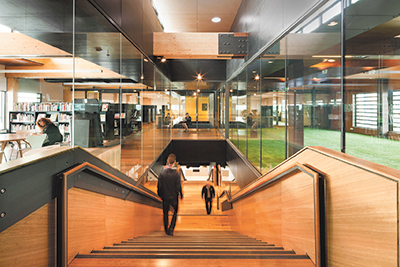
A ground-breaking Australian study has recently concluded that natural-looking wooden surfaces in the workplace are strongly associated with increased employee wellbeing and satisfaction, affording potential significant improvements to their productivity.
That’s the takeaway from research by strategic market research firm Pollinate and the University of Canberra.
Based on a survey of 1000 indoor Australian workers, the research provides evidence to underpin the business case that exposure to natural materials like wood helps to increase human health and wellbeing.
The study found that the more natural looking wooden surfaces workers could see from their workstation, the higher their workplace satisfaction and wellbeing. In addition, employees working in offices with natural wooden surfaces on average also reported higher personal productivity, mood, concentration, clarity, confidence and optimism.
It’s becoming increasingly clear that responsibly sourced timber has clear health and happiness benefits, as well as being a weapon in the struggle against climate change by both storing carbon and reducing carbon emissions.
Why you should consider a Wood Encouragement Policy
Planet Ark Environmental Foundation’s Make It Wood campaign aims to encourage the increased use of responsibly sourced wood as a building material. A key part of this initiative is the adoption of Wood Encouragement Policies (WEPs) throughout Australia.
A WEP generally requires responsibly sourced wood to be considered, where feasible, as the primary construction material in all new-build and refurbishment projects.
There are now two Local Government Authorities and 15 local councils that have adopted a WEP in Australia, and in June 2017 Tasmania became the first state in Australia to adopt a state-wide policy.
So, why don’t you consider adopting a Wood Encouragement Policy?
For more information please contact David Rowlinson, Make It Wood Campaign Manager, at david[@]planetark.org or 0400 474 412.
*Copy supplied by PlanetArk