While the iconic outback South Australian town of Coober Pedy is best known for its opals and unique underground accommodation, it might yet be recognised as Australia’s most energy-sustainable community.
The town has been operating a hybrid power station comprising wind, solar, batteries and diesel since 2017, providing an electricity supply that has averaged 75 percent renewable – including a record for the amount of time the local grid has been operating at 100 percent renewable, 97 hours in December last year.
The $38.86 million Coober Pedy Hybrid Renewable Project is a partnership between Coober Pedy District Council and Brisbane-based global distributed energy producer EDL, supported by $18 million funding from the Australian Renewable Energy Agency.
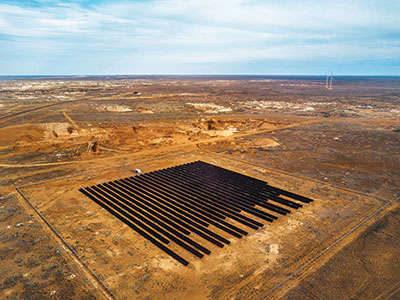
The project, which combines 4MW wind generation, 1MW solar generation, a 1MW/500kWhr battery and other integration technologies with the diesel power station, has now been widely recognised as having set a global benchmark for renewables in off-grid remote communities.
It won the 2019 Asia Power Awards’ Environmental Upgrade of the Year, and the energy sector’s award in Excellence in Innovation: Productivity Improvement at the South Australian Premier’s 2018 Awards in Energy and Mining. District Council of Coober Pedy has also been named a finalist in this year’s Local Government Professionals Australia, South Australian Leadership Excellence Award in the category of Excellence in Environmental Leadership and Sustainability.
It shines a rather different light on a council that found itself in disgrace after a scathing report by the South Australian Ombudsman for failing to undertake a tender process in relation to the project.
This failure ultimately led to the suspension of the council and the appointment of an administrator, former Playford Council Chief Executive Officer Tim Jackson, providing a salient reminder to councils across the nation of the need to ensure that good governance practices are maintained, especially when it comes to spending ratepayers’ funds.
Coober Pedy is unique in South Australia because it manages the provision of water and electricity services to its community of around 1800 people.
It is a particularly large energy consumer given that it operates a high pressure desalination plant, treating local artesian water with a high salt content, that requires a significant amount of energy.
Council also runs a sewage treatment plant that recycles waste water as grey water for community recreation areas and tree plantings.
Despite the early controversy, Jackson believes the deal has been ‘definitely a good thing’ for Coober Pedy ratepayers, providing an excellent financial outcome for Council and the community due to the fact that it was underwritten by the State Government’s Remote Area Energy Subsidy Scheme.
This means that power prices in Coober Pedy are the same as the average prices charged in Adelaide some 850km further south. The subsidy is guaranteed for the life of the power purchase agreement.
A Risk Management Plan that identified, assessed, and mitigated risks was adopted.
The main technical risks of the project involved integrating diesel and renewable energy sources to take into account the volatility of wind and solar energy in order to produce a reliable and seamless flow of electricity.
Jackson says the financial risks to Council were virtually eliminated due to the reciprocal agreement with the State Government to subsidise power costs.
In return, the power station has delivered lower cost and more stable electricity for the community at world-leading renewable energy penetration rates.
Whilst the project has had minimal impact on the Council’s power needs, the community now has a facility that is scalable with spare generation capacity to supply power to new industries such as compressed hydrogen, bio-plantations for market gardening and mining expansion. Jackson said these potential opportunities have yet to be explored.
Because EDL, which manages a global portfolio of power stations in Australia, North America and Europe, had owned and operated Coober Pedy’s original diesel-fuelled power station for years, it ‘understood the community’s concern around volatility of diesel prices’ according to Chief Executive Officer, James Harman.
“The Coober Pedy Hybrid Renewable Project sets a global benchmark for renewables in off-grid, remote communities and has already provided invaluable learnings for other hybrid renewable projects across the country.
“EDL has applied learnings from the Coober Pedy project to develop projects at other remote locations, such as the Agnew Hybrid Renewable Project in the Western Australian goldfields.
“When completed in mid 2020, Agnew will be Australia’s largest hybrid renewable energy microgrid and the first to utilise wind generation at a mine site.”
Meanwhile, a Council-convened environmental working group continues with its mission to make Coober Pedy the most sustainable town in Australia. The hard work has already been done.