Home » Canopy sprinklers control flying-foxes

Canopy sprinklers control flying-foxes

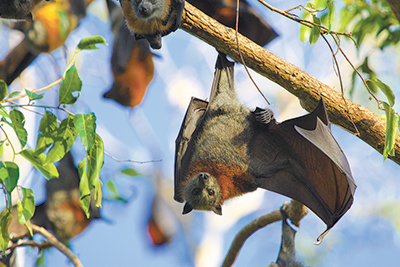
A proactive approach to flying-fox management is delivering nation-leading results for the Sunshine Coast Council in Queensland.

The humble sprinkler is proving to be an effective tool to manage flying-foxes across the Sunshine Coast as council works in partnership with local residents to manage suburban roosts.

Council recently voted to extend the use of proactive management techniques following a three-year trial funded through the Environment Levy.

Environment Portfolio Councillor Jenny McKay said flying-foxes irregular roosting habits presented a challenge for local councils.

“Council appreciates that flying-fox management does present challenges, particularly for communities where there are large roosts,” Cr McKay said.

“This report demonstrates that the best outcomes are achieved by partnering with the community, empowering local residents to have direct involvement in innovative management techniques and leading the way in education and research.

“In addition to managing vegetation and creating buffer zones, we have initiated an innovative partnership approach which gives residents the ability to control the use of canopy-mounted sprinklers to deter flying-foxes from buffer zones; this has proven to be very effective.

“While moving these animals on can provide temporary relief for affected residents, there are also no guarantees that the flying-foxes may not return, sometimes within days.

“By managing the surrounding areas, and keeping a level of distance between residents and flying-fox roosts, we’re doing everything we can to minimise interactions and reduce the effects of noise and odour that can come from large roosts.”

Council has also embarked upon a nation-leading flying-fox tracking project to gain a better understanding of the species’ habits.

That research is now being included as an education resource in the national primary school curriculum.

“We know that flying-foxes are highly nomadic creatures and we cannot control where they land, but we are working with some of Australia’s most esteemed researchers from the University of Queensland, CSIRO and the University of Melbourne to learn as much as we can about the factors that affect their roosting habits,” Cr McKay said.

“We have successfully used satellite tracking of a number of flying-foxes to gather data over a six-month period, and that data is now being analysed to give us a better picture of where these animals travel, not just within our region, but across Australia.

“We are also trialling use of acoustic fences to address noise issues caused by large flying-fox roosts, and investigating ways to potentially attract flying-foxes to alternative habitats, such as environmental reserves, to try and coax the animals out of suburban areas.

“The results of this ongoing research will continue to inform our flying-fox management practices into the future.”

Digital Editions


  • Murray Library upgrade open

    Murray Library upgrade open

    The Murray Library refurbishment is now complete, and the revitalised space is officially open to the community. The upgrade delivers a brighter, more accessible and…

More News

  • Leaving on a high

    Leaving on a high

    Mount Alexander Shire Council’s Chief Executive Officer Darren Fuzzard will end his tenure at the council in July 2026, marking ten years of service to the organisation and community. Mr…

  • Safety first for transport corridor

    Safety first for transport corridor

    Traversing a major Townsville transit corridor spanning three suburbs will soon be safer for motorists, cyclists and pedestrians, with Townsville City Council commencing a $3.8 million upgrade of Hugh and…

  • Creating long-term employment pathways

    Creating long-term employment pathways

    The Shire of Carnarvon is creating long-term employment pathways and strengthening workforce capability through its participation in the Remote Jobs and Economic Development (RJED) Program, a national initiative designed to…

  • Cool summer plan for Campbelltown

    Cool summer plan for Campbelltown

    Extreme heat is the biggest killer of natural disasters in Australia, exceeding that for any other environmental disaster combined, including floods, storms, bushfires and cyclones. While high temperatures pose risks…

  • Bathurst has it’s scrap together

    Bathurst has it’s scrap together

    Bathurst Regional Council has successfully concluded its ‘Let’s Get Our Scrap Together’ campaign, launched on 1 September 2025 with funding from the NSW Government and delivered in collaboration with NetWaste…

  • Baw Baw acting CEO tenure extended

    Baw Baw acting CEO tenure extended

    Baw Baw Shire Council has extended the contract of Acting Chief Executive Officer Sally Jones until 30 June 2026. The matter was considered as a confidential item in the late…

  • Farewell to a much-loved bridge

    Farewell to a much-loved bridge

    Narrabri Shire Council hosted a special community farewell event in mid-January, Brekkie on the Bridge, ahead of the upcoming demolition of the Violet Street Bridge. The event brought together community…

  • Toolkit provides resources for staff to live values

    Toolkit provides resources for staff to live values

    Organisational values are at the core of every workday and task and Bundaberg Regional Council has developed a practical tool kit to support its workforce and promote its values. The…

  • New system for Blacktown

    New system for Blacktown

    Blacktown City Council has launched DAISY, a new digital planning assistant designed to help residents better understand planning requirements and prepare residential development applications. DAISY, which stands for Development Application…

  • NSW mourns long-serving Governor

    NSW mourns long-serving Governor

    On behalf of the family of Dame Marie Bashir, I am saddened to share the news of her passing. Married to Sir Nicholas Shehadie AC OBE for 61 years, and…